Case Study — AI Agent Automation
Autonomous Lead
Enrichment Agent
An AI agent that autonomously discovers, scrapes, and enriches B2B leads against custom criteria — combining Playwright scraping, schema-validated LLM extraction, and third-party enrichment into a single n8n-orchestrated pipeline that outputs scored, CRM-ready lead lists.

Agent Pipeline
Overview
Replacing Manual Prospecting with a Criteria-Driven Agent
Sales and recruiting teams spend hours every week manually searching company websites and directories to build prospect lists — slow, inconsistent, and hard to scale with pipeline targets. Static databases like Apollo or ZoomInfo help, but lack the flexibility to combine custom scraping criteria with autonomous discovery. This project builds that missing layer: an agent that takes a criteria set and returns a scored, verified, CRM-ready lead list.
The Problem
Manual Prospecting Doesn't Scale
- Manual research across company sites, directories, and LinkedIn eats hours per batch
- Static lead databases can't apply custom, evolving qualification criteria
- Direct LinkedIn scraping carries real legal/ToS risk if handled carelessly
- No single pipeline connects discovery → extraction → verification → CRM delivery
The Solution
An n8n-Orchestrated Discovery-to-CRM Pipeline
A criteria set (industry, company size, location, keywords) triggers an n8n workflow that scrapes configured sources, extracts structured contact data with an LLM validated against a strict Pydantic schema, enriches and verifies each lead through Hunter.io and Proxycurl, scores it against ICP fit, deduplicates against existing records, and delivers the result as CSV or a HubSpot push — with a Slack notification on completion.
System Architecture
Five Layers: Orchestration to Delivery
The agent's reasoning layer is kept deliberately separate from its execution layer (scraping, API calls) — a design choice that makes each stage independently testable and debuggable, and avoids over-engineering a full autonomous agent framework where a well-structured pipeline does the job just as effectively.
Automation Workflow
The n8n Workflow Behind the Pipeline
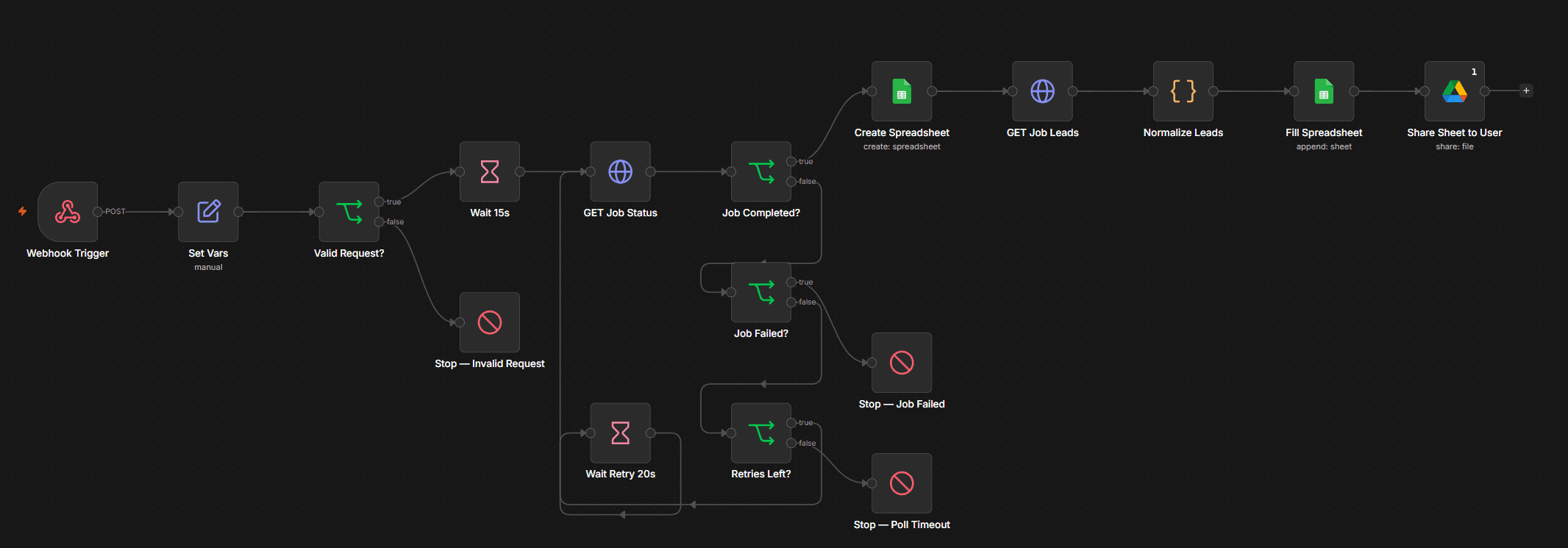
This n8n workflow drives the full run — triggering the scraper, calling the extraction and enrichment services, running the scoring step, and delivering the finished lead list to CSV/HubSpot with a Slack notification on completion.
Key Features
Built for Reliability, Not Just Speed
Technical Highlights
Key Engineering Decisions
Pipeline vs Full Agent Framework
Reserving Autonomy for Where It Earns Its Complexity
A full multi-agent framework (LangGraph/CrewAI) was evaluated and rejected for MVP — a well-structured n8n pipeline with a single LLM scoring/decision step is simpler, cheaper, and just as effective. Agent autonomy is reserved for genuinely ambiguous steps like dynamic source selection, where a fixed pipeline would fall short.
Full 12-Phase SDLC
Documentation-Driven Engineering
Beyond code, the project was delivered through a complete software development lifecycle — requirements and feasibility studies, a risk register, architecture and data-flow diagrams, a security review against OWASP Top 10, a test plan with negative cases, and a deployment/monitoring runbook — producing a documentation library alongside the working system.
Technology Stack
From Scraping to CRM Delivery
Built By
Development Team

Mujadid Sana
Developer
Mohsin Sabir
DeveloperNeed a custom lead-gen or scraping agent built?
We design and build AI-driven scraping, extraction, and enrichment pipelines — from architecture and risk assessment through to a working, monitored system.